A custom swim trunk order lives or dies on three specifications that have nothing to do with the artwork: how long the leg is, what sits inside it, and what the shell is made of. Get those three right and the print looks good on a garment people actually want to wear; get them wrong and you have a beautiful design on trunks that ride up, sag when wet, or turn see-through in the pool. This walkthrough takes the three decisions in the order that matters, so you can hand a supplier a spec that leaves nothing to chance.
Start with the inseam
The inseam — the seam length from crotch to hem — sets the whole silhouette, and swimwear has settled around three standard lengths. A 5-inch inseam lands at the mid-thigh; it reads athletic and modern, shows leg, and tends to suit shorter wearers, roughly under 5-foot-8, and anyone with muscular thighs who wants room to move. A 7-inch inseam hits just above the knee and is the versatile default — the length that works for the widest range of builds and the one that outsells the others year after year, which makes it the safe choice for a general run. A 9-inch inseam reaches to or just below the knee for the classic board-short look, and it balances proportions best on taller wearers, roughly six foot and up.
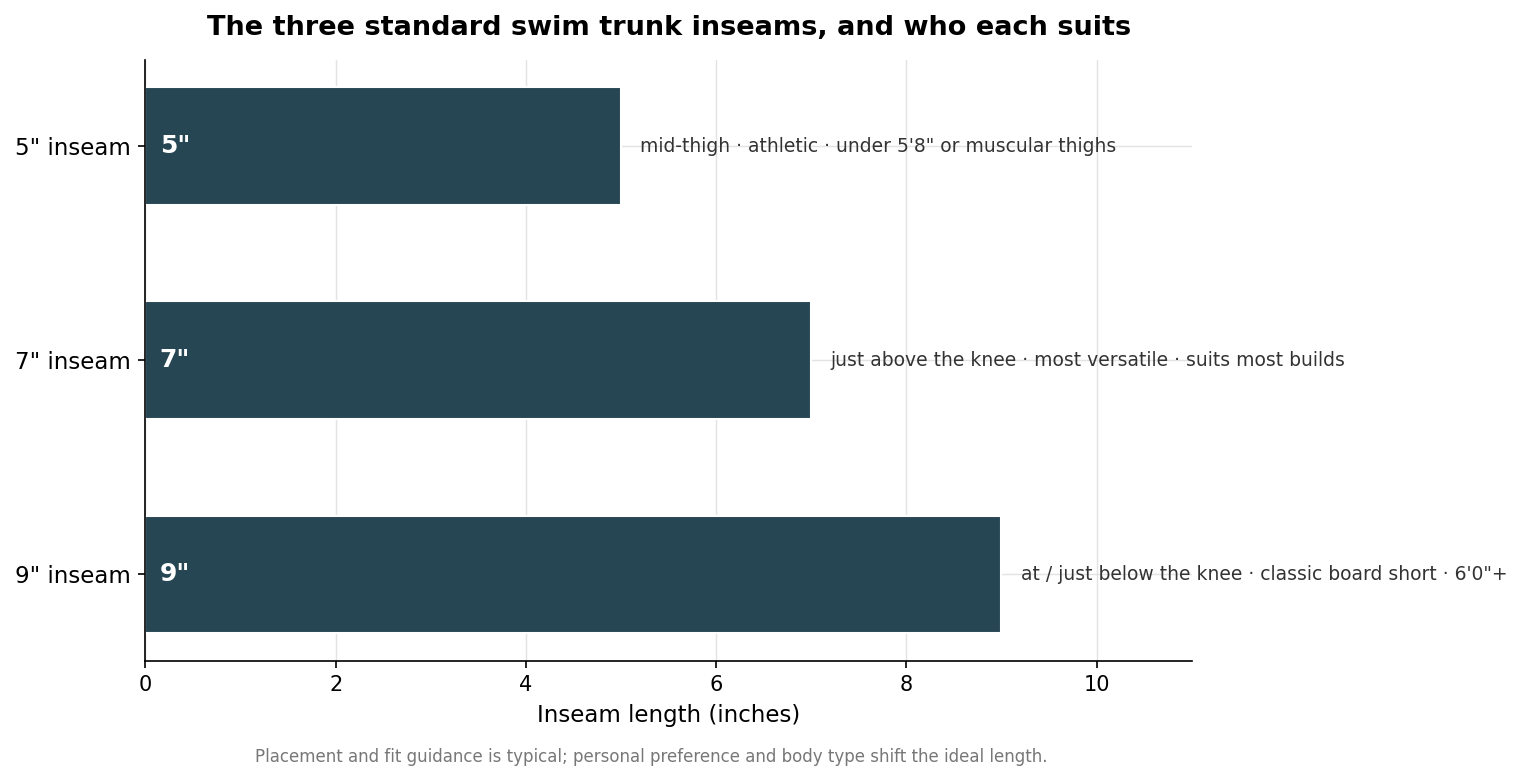
As a rough height rule, wearers under about 5-foot-8 are best served by a 5-inch or 7-inch length, while those over six foot look better in a 7-inch or 9-inch. If you are ordering a single length for a mixed group — a team, a resort staff, a promotional run — the 7-inch is the least risky compromise. If the budget allows two lengths, offering 5-inch and 7-inch covers most preferences without stocking three sizes of everything. Treat these as starting points rather than rules; fit preference varies, and it is worth confirming against a size sample before committing a large quantity.
Then choose the liner
The liner is the decision buyers forget until the trunks arrive, and it changes the garment more than any other internal detail. There are three common approaches. A mesh brief liner is the traditional netted panel sewn inside; it is the most economical, drains and dries fast, and gives basic support, but the netting can feel abrasive over a long, active day and it tends to trap sand. A compression liner is effectively a boxer-brief in a polyester-spandex blend built into the trunk; it holds everything in place, cuts down on chafing during real activity, and suits water sports and long wear, at a higher price and a snugger fit that not everyone likes. Going unlined — the true board-short approach — gives maximum breathability and the fastest drying with total freedom of movement, but offers no support and can turn sheer when wet, so it works best for lounging and sunbathing rather than swimming laps.
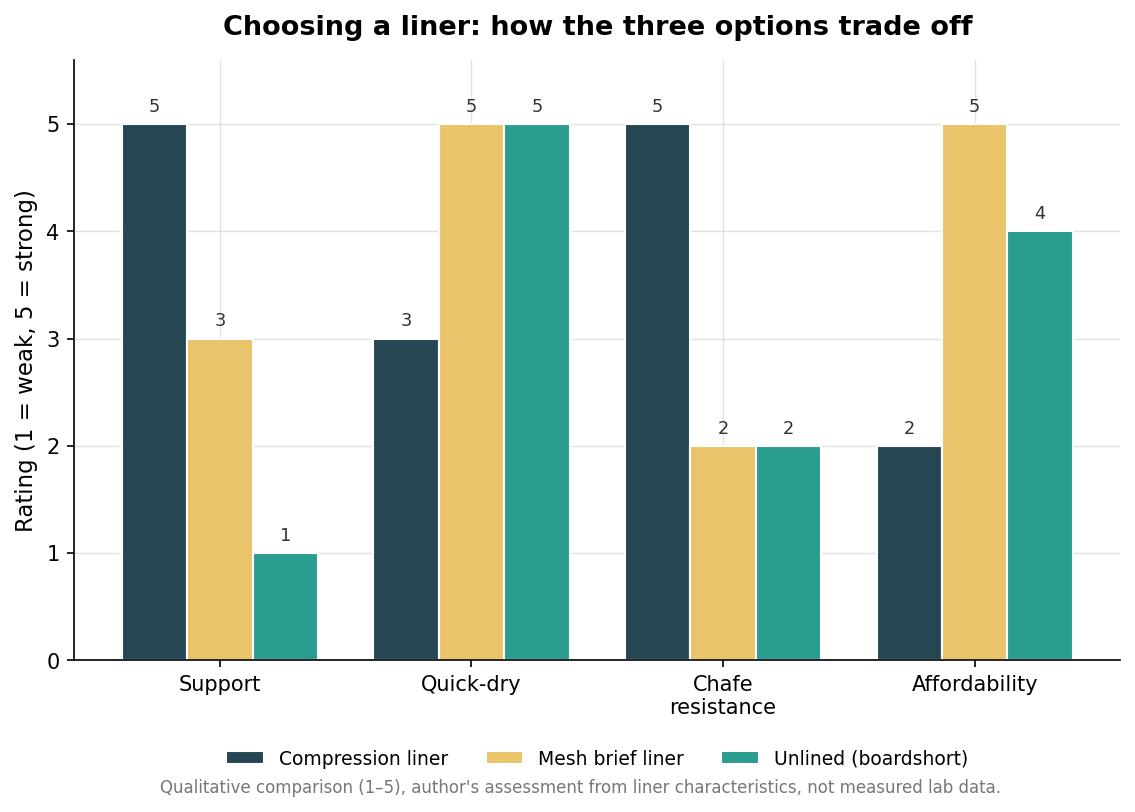
Match the liner to the dominant use. For a resort or general retail run where people mostly lounge and take a dip, a mesh brief keeps the price down and dries quickly. For anything active — surf, wakeboarding, beach volleyball, a swim team — a compression liner is worth the premium for the chafe control alone. Reserve unlined trunks for markets that specifically want the board-short feel and understand the transparency trade-off, and if you do go unlined, specify a slightly heavier or lined-look shell so a wet garment is not revealing.
Specify the fabric
Most swim trunks are built from polyester, usually blended with a small share of spandex or elastane for stretch. Polyester is the workhorse here for good reasons: it resists chlorine and salt, dries quickly, holds color well, and — critically for a custom order — it is the fiber that all-over dye-sublimation printing bonds to. If you want edge-to-edge graphics or a repeating pattern rather than a small logo, the shell effectively has to be a light-colored polyester, because sublimation dyes will not take on cotton or on dark grounds. A typical stretch blend runs somewhere around 5 to 20 percent spandex; more stretch means a closer, athletic fit, while a straight polyester or poly-nylon shell gives the looser, structured board-short drape. Recycled polyester, often labeled rPET and spun from post-consumer plastic, performs almost identically to virgin polyester and is worth specifying if sustainability is part of the brand story — just confirm the recycled content with the supplier rather than assuming it.
A few finishing details round out the fabric decision. Confirm quick-dry performance and, for pool-heavy use, chlorine resistance, since not every polyester blend is finished the same way. And align the print method with the fabric from the start: all-over sublimation for full-coverage graphics on light polyester, or screen and heat-transfer printing for a placed logo on a wider range of colors.
Nail the waistband and the order details
Two more choices shape how the trunks fit and how smoothly the order goes. First, the waistband: an elastic waist with an internal drawcord is the swim-trunk standard, forgiving across a range of sizes and the reason a single size can fit slightly different bodies. A flat, lace-up board-short waist looks cleaner and sits closer, but it is less adjustable and better reserved for fitted styles or wearers who know their size precisely. For a mixed group where you cannot measure everyone, the elastic-and-drawcord waist is the safer default.
Second, treat sizing and sampling as part of the spec rather than an afterthought. Ask the supplier for a size chart tied to actual waist measurements, not just S-M-L labels, because swimwear sizing varies more between makers than most apparel. Order a pre-production sample in the exact fabric, inseam, and liner you have chosen and have someone wear-test it wet before you approve the full run — wet behavior, transparency, and drying speed are things you cannot judge from a flat garment. Confirm the minimum order quantity, the size breakdown you will receive, and the turnaround up front. Lock the inseam, the liner, the fabric, and the waistband in that order, put each on the spec in writing, and the artwork lands on a garment built to wear as well as it looks.